"Is this normal for their age?" is probably the most repeated question about baby sleep. Here's a full month-by-month reference chart, to have a real point of comparison — without replacing your own baby's rhythm.
Sleep chart by month
| Age | Naps | Total sleep/day | Longest night stretch |
|---|---|---|---|
| Newborn (0-6 weeks) | 4-5 (irregular) | 15-17h | 2-3h |
| 2 months | 4-5 | 14-17h | 3-4h |
| 3 months | 3-4 | 14-16h | 4-5h |
| 4 months | 3-4 | 14-16h | 4-5h |
| 5 months | 3-4 | 13-15h | 5-6h |
| 6 months | 2-3 | 13-15h | 6-7h |
| 7 months | 2-3 | 13-15h | 6-8h |
| 8 months | 2-3 | 12-14h | 7-8h |
| 9 months | 2 | 12-14h | 8-9h |
| 10 months | 2 | 12-14h | 8-10h |
| 11 months | 2 | 12-14h | 8-10h |
| 12 months | 2 (or transitioning to 1) | 12-14h | 9-10h |
These are reference ranges, not a test to pass. Some babies naturally sleep more, others less, within a perfectly healthy range — what matters most is the general trend, not comparing a single day against the chart.
How a typical day shapes up, month by month
- 0-3 months: no fixed schedule — the baby eats and sleeps guided by hunger and sleepiness, in short, unpredictable cycles.
- 4-5 months: more regular patterns start to emerge, with 3-4 naps spread across the day.
- 6-8 months: a 3-nap schedule usually settles in and then drops to 2, with a long midday nap anchoring the day.
- 9-12 months: 2 more stable naps (morning and afternoon), with night sleep already concentrated into one long stretch.
What age does a baby sleep through the night?
It varies a lot from baby to baby, but there's a general pattern: many start doing long nighttime sleep stretches (5-6 hours in a row) between 3 and 6 months, and some don't consolidate a full night until closer to a year. "Sleeping through the night" for babies usually means that — a long stretch without waking, not necessarily 12 hours straight like an adult.
Two factors that tend to speed up or delay that milestone: whether the baby is still waking for real hunger (see when night weaning makes sense), and whether their daytime naps are well covered — an overtired baby during the day sleeps worse at night, not better.
Why this chart is only the starting point
Every baby has their own temperament, their own circadian rhythm, and their own way of moving through each stage. A 6-month-old still taking 3 naps, or a 9-month-old who's already down to 1, can be perfectly within the expected range. The chart is here to orient you, not to trigger alarm if your baby doesn't fit exactly into one row.
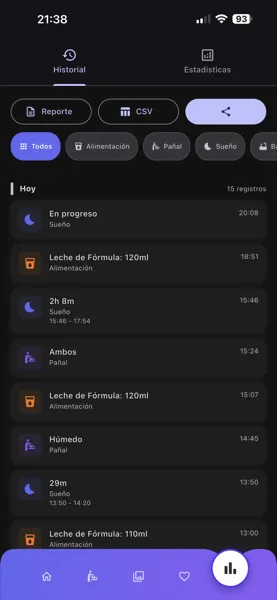
Full daily timeline — a real screen from the Alfonso app.
Start logging today
Create your baby's profile in 30 seconds, no account or password needed, and log the next event as it happens — to see the real pattern, not just remember it. Syncs automatically with your partner.


Frequently asked questions
At what age does a baby sleep through the night?
Varies a lot — many start long stretches between 3 and 6 months, others consolidate only closer to a year.
How many naps does my baby need by age?
From 4-5 as a newborn down to a single nap between 12-18 months, with 3-nap and 2-nap stages in between — check the signs for each transition if your baby is fighting one.
How many total sleep hours does a baby need per day?
Between 14-17 hours as a newborn, dropping to 12-14 hours around the first birthday.
Keep reading
ℹ️ This article is informational and doesn't replace a pediatrician's judgment. If you have specific concerns about your baby's sleep, always check with a healthcare professional.